

Is forex trading legal in India? Yes, but only in a narrow form most people never see advertised. You can trade currency futures and options on a recognised Indian exchange through a SEBI-registered broker. Almost everything else is off limits, including the leveraged apps and offshore platforms that fill your social feed.
That gap causes real damage. Thousands of Indian traders deposit with platforms that look official, quote an “FIU registration” or an “RBI approval”, and then refuse withdrawals. Some of those traders also learn later that they broke FEMA rules themselves.
This guide explains what the law actually allows, which pairs you can trade, what happens if you use an offshore broker, and how to check a platform before you send a single rupee.
Quick answer: Forex trading is legal in India only through currency derivatives on NSE, BSE or MSE, using a SEBI-registered broker. You can trade INR pairs (USD-INR, EUR-INR, GBP-INR, JPY-INR) and a few cross pairs such as EUR-USD. Sending money abroad to trade on margin with an offshore broker breaks FEMA and the Liberalised Remittance Scheme, and the RBI publishes an Alert List of platforms it has not authorised. No “RBI-approved forex app” exists.
Legal vs. Illegal Forex Trading in India at a Glance
| Activity | Status in India | Why |
|---|---|---|
| Currency futures and options on NSE, BSE or MSE | Legal | Exchange-traded, SEBI-regulated, permitted by RBI |
| Trading USD-INR, EUR-INR, GBP-INR, JPY-INR on an exchange | Legal, with conditions | Positions must hedge a real currency exposure (RBI rule effective 3 May 2024) |
| Trading EUR-USD, GBP-USD, USD-JPY on an exchange | Legal | Cross-currency derivatives allowed on Indian exchanges |
| Using a SEBI-registered stockbroker for currency segment | Legal | The only authorised route for retail traders |
| Opening an account with an offshore forex or CFD broker | Not permitted | Remitting money for margin trading breaks FEMA and LRS rules |
| Spot forex or CFD trading via international apps | Not permitted | Not authorised by RBI, often listed on the RBI Alert List |
| Paying an offshore broker by card, UPI or crypto | Not permitted | Still counts as an unauthorised forex transaction |
| Buying foreign currency for travel or education | Legal | Allowed under LRS for genuine current-account purposes |
In short, the platform and the purpose decide legality, not the currency itself.
What the Law Says: FEMA, RBI and SEBI
Three pieces fit together here. Once you see how, the rules stop feeling arbitrary.
FEMA Sets the Boundary
The Foreign Exchange Management Act, 1999 (FEMA) governs every foreign exchange transaction by an Indian resident. Under FEMA, you may deal in foreign currency only with an authorised person and only for a permitted purpose. Speculative margin trading with an overseas counterparty is not one of those purposes.
The RBI Decides What Is Permitted
The Reserve Bank of India writes the rules under FEMA. It authorises banks and other entities to deal in forex, and it sets the conditions for exchange-traded currency derivatives. The RBI also publishes the Alert List, a running list of platforms that are not authorised to offer forex trading to Indian residents.
SEBI Regulates the Exchanges and Brokers
The Securities and Exchange Board of India supervises the exchanges where currency derivatives trade and registers the stockbrokers who offer them. That makes SEBI registration the practical test for any platform you use.
The Liberalised Remittance Scheme Does Not Cover Margin Trading
Many traders assume the Liberalised Remittance Scheme (LRS) lets them fund an overseas trading account. LRS allows a resident to remit up to USD 250,000 per financial year for permitted purposes such as travel, education or overseas investment. The scheme specifically excludes remittances for margin trading or margin calls abroad. So using LRS to fund a leveraged forex account breaks the rules, even when the bank processes the transfer.
Which Currency Pairs Can You Legally Trade in India?
Indian exchanges list two groups of currency derivatives. The rules differ for each, and this is the detail most guides skip.
| Pair | Group | Contract size | Condition |
|---|---|---|---|
| USD-INR | INR pair | USD 1,000 | Underlying exposure required |
| EUR-INR | INR pair | EUR 1,000 | Underlying exposure required |
| GBP-INR | INR pair | GBP 1,000 | Underlying exposure required |
| JPY-INR | INR pair | JPY 100,000 | Underlying exposure required |
| EUR-USD | Cross pair | EUR 1,000 | No exposure rule |
| GBP-USD | Cross pair | GBP 1,000 | No exposure rule |
| USD-JPY | Cross pair | USD 1,000 | No exposure rule |
All contracts are futures or options. They are cash-settled in rupees, so no foreign currency changes hands. You cannot trade spot forex or CFDs on an Indian exchange.
The 2024 Underlying Exposure Rule
In early 2024, the RBI reiterated that rupee-linked currency derivatives exist for hedging, not speculation. From 3 May 2024, anyone trading INR pairs must have a genuine underlying currency exposure, such as import payments, export receipts or a foreign loan. Users may still open positions up to USD 100 million without submitting proof upfront. The exposure, however, must exist.
For a retail trader with no foreign currency business, this means INR pairs are effectively closed for pure speculation. Cross pairs remain open, which is why most retail activity has shifted there.
Trading Hours
Currency derivatives on Indian exchanges trade on weekdays from 9:00 am to 5:00 pm IST. Cross-currency contracts may have extended hours into the evening. Check your exchange’s current timetable before planning trades around London or New York sessions.
How to Trade Forex Legally in India in 5 Steps
- Pick a SEBI-registered broker with a currency segment. Confirm the registration on SEBI’s own list of intermediaries, not on the broker’s website.
- Complete KYC and activate the currency derivatives segment. You’ll need PAN, Aadhaar-linked KYC, an Indian bank account and a demat or trading account.
- Declare your exposure if you plan to trade INR pairs. Without a genuine hedging need, stick to cross pairs such as EUR-USD.
- Learn the contract specs and margin rules. Exchanges set margins, so leverage is far lower than offshore apps advertise. That’s a feature, not a flaw.
- Keep clean records for tax. Every contract note matters at filing time.
All of your money stays inside the Indian banking system, under SEBI and exchange supervision. That’s the real protection you give up the moment you deposit offshore.
How Is Forex Trading Taxed in India?
Profits from exchange-traded currency derivatives are generally treated as non-speculative business income, not capital gains. They’re taxed at your slab rate, and losses can usually be set off against other business income and carried forward. You’ll typically file using a business-income return and may need a tax audit above certain turnover levels. Tax treatment depends on your full situation, so confirm the details with a chartered accountant.
Profits from offshore platforms are still taxable in India. Declaring them doesn’t make the underlying trading legal, though, and may draw FEMA questions.
There’s No Such Thing as an RBI-Approved Forex App
Search for “RBI approved forex trading app” and you’ll find hundreds of ads making that exact promise. None of them can back it up. The RBI does not approve or license retail forex trading apps. It authorises banks and dealers, and it permits exchange-traded currency derivatives through SEBI-registered brokers. That’s the full list.
If an app says “RBI approved” and offers spot forex, CFDs, gold or high leverage, treat the claim as false. A legal Indian platform describes itself as a SEBI-registered stockbroker with a currency segment, and its registration number appears in SEBI’s records.
FIU Registration Is Not a Forex License
A newer tactic is the “FIU registered” badge. Registration with the Financial Intelligence Unit-India (FIU-IND) is an anti-money-laundering reporting duty. It applies to entities such as virtual digital asset service providers. It does not authorise anyone to offer forex or CFD trading to Indian residents. A platform leaning on FIU registration as proof of legitimacy is either confused about the law or counting on you to be.
“SEBI Approved” Claims Need a Number
Some offshore platforms simply copy SEBI’s name. Ask for the registration number. Stockbrokers registered with SEBI carry numbers that begin with “INZ”. Then search that number on SEBI’s intermediary list and make sure the legal name matches the company taking your money.
What Is the RBI Alert List?
The RBI Alert List names entities that are not authorised to deal in forex or run electronic trading platforms for forex. The RBI first published it in February 2022 with a few dozen names. It has grown steadily since and now runs to roughly a hundred entries.
Three things about the list matter more than its length:
- It isn’t exhaustive. The RBI says plainly that a platform’s absence from the list does not mean it is authorised.
- It covers promoters, not just brokers. Websites, apps, social media accounts and “training” outfits that advertise unauthorised forex platforms can appear on it.
- It applies to you as well. The RBI has warned that residents who deal with unauthorised platforms can face action under FEMA.
So the right question isn’t “is this platform on the Alert List?” It’s “is this platform a SEBI-registered broker offering exchange-traded contracts?” If not, it isn’t legal for you to use.
Penalties for Illegal Forex Trading in India
The consequences fall on both sides of the trade.
For traders: A FEMA contravention can attract a penalty of up to three times the amount involved, where that sum can be quantified. Where it can’t, the penalty can reach ₹2 lakh. A continuing contravention adds up to ₹5,000 for each day it continues. FEMA penalties are civil, but the Enforcement Directorate can also freeze bank accounts tied to suspect payments.
For operators and promoters: People running or promoting illegal platforms can face money-laundering charges, cheating charges under criminal law, and asset seizures. Indian authorities have frozen large sums in accounts used to collect deposits for unauthorised forex apps.
There’s also a practical penalty that no statute lists. If an offshore platform keeps your money, Indian regulators have no power over it. Legal recovery becomes slow, expensive and often impossible.
How to Check if a Forex Platform Is Legal in India
Run these checks before you deposit anything. Each takes a couple of minutes.
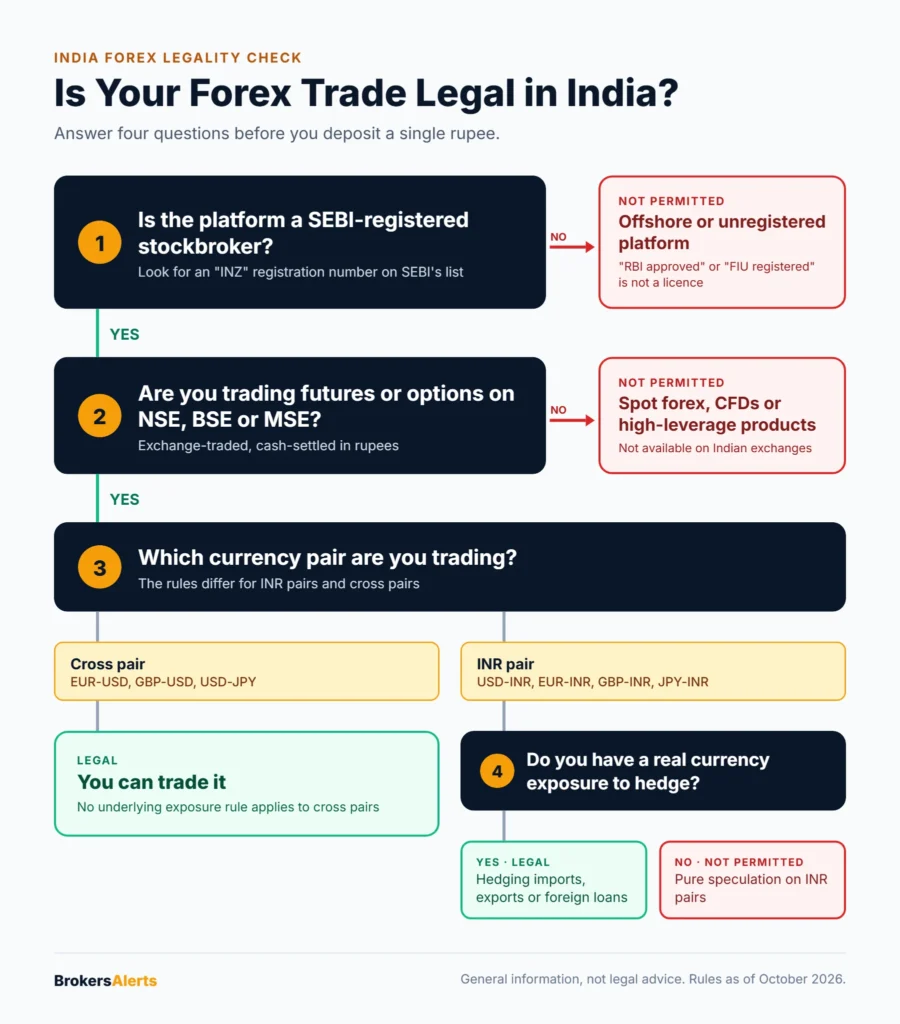
- Search SEBI’s list of registered stockbrokers for the exact legal name and an “INZ” registration number.
- Confirm the currency derivatives segment is active with NSE, BSE or MSE.
- Check the RBI Alert List for the platform, its app name and its website.
- Look at how deposits work. Legal brokers take funds into a designated client bank account in the broker’s name. UPI transfers to a personal account, a random company or a crypto wallet are a hard stop.
- Read the product list. Spot forex, CFDs, 1:500 leverage, bonus credits or crypto pairs mean you’re not dealing with an Indian exchange.
- Ignore Telegram and WhatsApp “signals” groups that steer you to a specific app. Most unauthorised platforms recruit this way.
For a deeper walkthrough on reading licences and registers, see our guide on how to check if a forex broker is regulated.
What We Found When We Tested Offshore Brokers
Our reviews include a real withdrawal test, so we don’t have to guess how offshore platforms treat clients. Across nine brokers we reviewed, we deposited $1,850 in total. Eight of them, all relying on offshore licences or unconfirmed claims, kept $1,550 between them. The only full withdrawal came from a broker with a top-tier licence.
The problems we found are the ones India’s rules are built to keep out: licences from small offshore jurisdictions, shared licence numbers, regulator claims nobody could confirm, and contracting entities with no licence at all. You can read the full evidence in our Scam Warning reviews.
For the wider picture, read Is Forex Trading a Scam? What the Evidence Shows.
Lost Money to an Illegal Forex App? Do This Now
- Stop paying. Ignore any “tax”, “verification” or “unlock” fee requested before a withdrawal. It’s part of the scam.
- Save everything. Screenshots, chats, payment receipts, UTR numbers, app names and website addresses.
- Report it quickly. Call the national cybercrime helpline 1930 or file on the National Cyber Crime Reporting Portal. Speed matters, because banks can sometimes hold funds still in transit.
- Tell your bank. Ask it to flag the receiving account.
- Report the platform to the RBI through its Sachet portal for unauthorised entities. For a SEBI-registered broker, use SEBI’s SCORES complaint system instead.
- Avoid “recovery agents”. Anyone who promises to get your money back for an upfront fee is almost always running a second scam.
Then tell us. Every report adds dated evidence to our reviews and helps the next trader avoid the same platform.
Frequently Asked Questions
Is Forex Trading Banned in India?
No, it isn’t banned outright. It’s restricted. Exchange-traded currency futures and options through a SEBI-registered broker are legal. Trading with offshore forex or CFD platforms is not permitted under FEMA.
Is Forex Trading Legal in India for Students?
The rules are the same for everyone. A student aged 18 or over with PAN, KYC and a bank account can open a currency segment with a SEBI-registered broker. Offshore apps remain off limits regardless of age or account size.
Can I Start Forex Trading in India With 100 Rupees?
Not legally. Offshore apps advertise tiny minimum deposits, but they aren’t authorised. On Indian exchanges, the smallest contracts are 1,000 units of the base currency, and margin requirements usually run into a few thousand rupees per lot.
Can I Open a Forex Account With a Foreign Broker From India?
You can physically sign up, but funding it for margin trading breaks FEMA and the LRS rules. Card, UPI and crypto payments don’t change that. The account also gives you no Indian regulatory protection if withdrawals stop.
Do Popular Indian Trading Apps Allow Forex Trading?
Many large Indian stockbroking apps offer a currency derivatives segment, which is legal. Check that the app belongs to a SEBI-registered broker and that you’re trading exchange contracts. Spot forex or CFDs inside any app are a red flag.
What Is the 90% Rule in Forex?
It’s an informal saying: 90% of new traders lose 90% of their capital within 90 days. It isn’t a regulation. SEBI’s own studies of equity derivatives found that around nine in ten individual traders lost money, which suggests the saying isn’t far off for leveraged trading in general.
What Is the Punishment for Illegal Forex Trading in India?
Under FEMA, penalties can reach three times the amount involved, or up to ₹2 lakh where the sum can’t be quantified, plus up to ₹5,000 per day for continuing breaches. Operators and promoters can also face money-laundering and fraud charges.
Is Forex Trading Halal or Allowed for Islamic Accounts in India?
That’s a religious question with views on both sides, and it doesn’t change the legal position. Any “swap-free” offer from an offshore broker is still unauthorised for Indian residents.
The Verdict: Legal, Narrow and Safer Than It Looks
Forex trading is legal in India, but only on Indian exchanges through SEBI-registered brokers. INR pairs now need a real hedging purpose, while cross pairs remain open to retail traders. Everything outside that system, from “RBI approved” apps to FIU-registered platforms and offshore brokers with tiny deposits, puts both your money and your legal position at risk.
The Indian route feels limited next to 1:500 leverage and a slick app. It also keeps your money inside a system that answers to regulators you can actually reach.
Risk warning: Trading currency derivatives involves a high risk of loss, and most retail traders lose money. This guide is general information, not legal, tax or financial advice. Rules change, so confirm your position with a qualified professional before you trade. Read our full risk disclaimer.