
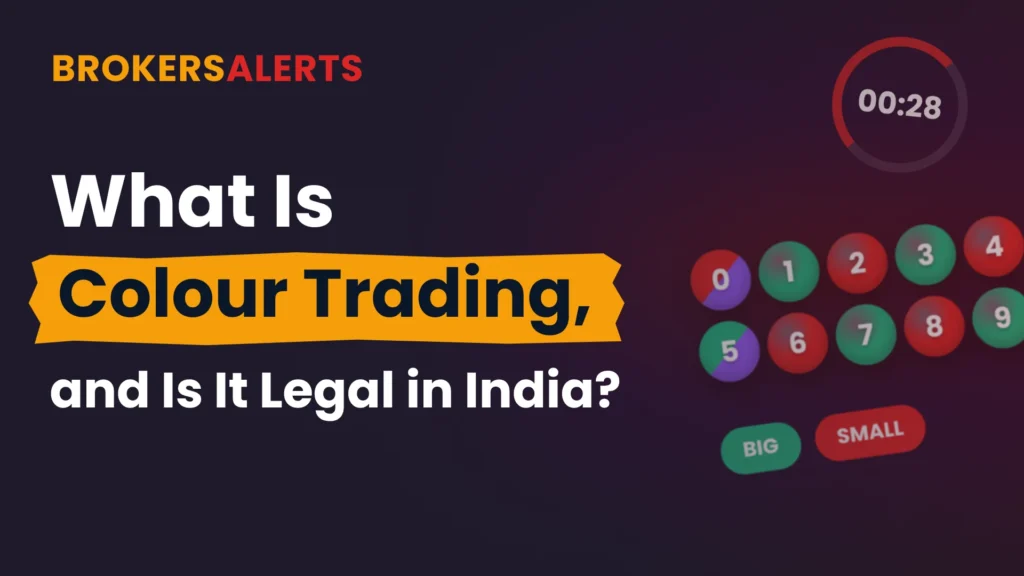
Quick answer: Colour trading is a betting game, not a form of trading. You stake money on which colour or number an app will show next, and the app decides the result. India’s Promotion and Regulation of Online Gaming Act, 2025 bans offering, advertising or processing payments for online money games, so these apps operate illegally.
Colour trading is a betting game sold with trading vocabulary, and in India it now sits squarely inside a 2025 law that bans online money games. The apps talk about charts, signals and “trading panels”. Underneath, you are guessing the next colour on a timer.
We spend most of our time at BrokersAlerts checking whether brokers are licensed and whether people can get their money out. Colour prediction apps keep turning up in the same conversations, usually from readers who thought they had found an easy way into trading. So this guide covers what these apps are, what Indian law says about them now, and why the maths works against every player.
What Is Colour Trading?
Colour trading is a game where you bet real money on the colour, number or size of a result that the app generates every few minutes. Colour trading: a fixed-odds bet on an app-generated result, marketed as trading.
A typical round looks like this:
- You add money to an in-app wallet, usually by UPI.
- A countdown starts, often 30 seconds, 1 minute, 3 minutes or 5 minutes.
- You pick green, red or violet, a number from 0 to 9, or “big” or “small”.
- The timer ends and the app shows a result.
- Winnings are added to your wallet balance, which you then ask to withdraw.
Nothing is bought or sold. There is no asset, no market and no other trader on the other side. The operator takes your stake, picks the outcome and pays out at odds it has set.
Why Is It Called Trading?
The trading label is marketing. A colour history looks a bit like a price chart, and words like “trading”, “panel” and “signal” sound more respectable than “betting”. That framing also helps promoters pitch it as a skill you can learn, which brings in people who would never open a betting app.
Why Colour Prediction Apps Aren’t Real Trading
A colour prediction app is a betting operator, while real trading means buying a regulated asset through a licensed intermediary. The difference shows up in every part of the transaction.
| Colour prediction app | Regulated trading in India | |
|---|---|---|
| What you get | A bet on the next result | Shares, units, futures or options |
| Who sets the outcome | The app | Buyers and sellers on an exchange |
| Where your money goes | A wallet, often funded through a stranger’s UPI ID | Your own account with a SEBI-registered broker |
| Licence | None. Offering it is prohibited | Broker registration with SEBI, trades on recognised exchanges |
| Proof of each trade | An in-app balance | A contract note for every trade |
| If something goes wrong | No regulator to complain to | Broker grievance cell, exchange and SEBI complaint routes |
| Long-run expectation | A built-in loss on every round | Depends on the market and your decisions |
If an app can’t tell you which exchange your order went to, it isn’t trading. Our guide on how to check if a broker is regulated walks through finding a licence number and confirming it on the official register.
Is Colour Trading Legal in India?
No. Offering, promoting or processing payments for colour trading is illegal in India under the Promotion and Regulation of Online Gaming Act, 2025. Parliament passed it in August 2025, and it bans all online money games, whether the operator calls them games of skill, games of chance or a mix of both.
Online money game: a game played online where you pay or deposit money expecting to win money back. Colour prediction fits that description exactly.
The penalties fall on the people running and promoting the apps:
| Who | Penalty under the 2025 Act |
|---|---|
| Anyone offering an online money game | Up to 3 years in prison, a fine up to ₹1 crore, or both |
| Anyone advertising one | Up to 2 years in prison, a fine up to ₹50 lakh, or both |
| Repeat offenders | Higher minimum terms and fines, up to 5 years and ₹2 crore for operators |
| Banks and payment systems | Barred from processing payments for these games |
The government can also block access to these platforms under the Information Technology Act, 2000. The Online Gaming Rules that put the Act into practice came into force on 1 May 2026 and set up a national regulator for online gaming.
Was Colour Trading Legal Before 2025?
Not really. Betting on games of chance was already gambling under the Public Gambling Act, 1867 and most state gambling laws. Several states had also passed their own bans on online betting. The 2025 Act removed the last bit of doubt by covering online money games nationwide.
What About the Supreme Court Challenge?
Gaming companies have challenged the Act, and the case is with the Supreme Court. As of our last update, the court has not struck the Act down. Whatever it decides, colour prediction was never a protected skill game. A random colour on a timer is about as clear a game of chance as exists.
Can Players Get in Trouble?
The Act’s penalties are written for operators, promoters, advertisers and payment facilitators. That doesn’t make playing safe. Winnings from online games are taxed at a flat 30%, losses can’t be set off against them, and you have no legal claim if the app refuses to pay you. Promoters who recruit others for a commission are a different case. Pushing people towards the app can count as promotion.
If you’re wondering which forms of currency trading are actually allowed, our guide on whether forex trading is legal in India explains the RBI and SEBI rules.
Can You Actually Make Money From Colour Trading?
Not over time. The payout table is set so the operator keeps a slice of every round, even if every result were perfectly fair.
Most of these apps use the same layout. There are ten numbers, 0 to 9. Odd numbers are green, even numbers are red, and 0 and 5 also count as violet. Many apps also take a service fee of around 2% from each stake. Here is what ₹100 is worth on average with typical payouts. Individual apps vary.
| Bet | Typical payout | Wins on | Average return per ₹100 | After a 2% fee |
|---|---|---|---|---|
| Big or small | 2x | 5 of 10 numbers | ₹100 | ₹98.00 |
| Green or red | 2x, or 1.5x if a violet number lands | 5 of 10 numbers | ₹95 | ₹93.10 |
| Violet | 4.5x | 2 of 10 numbers | ₹90 | ₹88.20 |
| Single number | 9x | 1 of 10 numbers | ₹90 | ₹88.20 |
Those losses compound fast. Someone betting ₹100 on green for 50 rounds a day should expect to lose about ₹345 a day on average. A lucky week changes nothing about the next one.
There’s also a bigger problem. These figures assume the draw is random. Nobody audits the result generator, so you are trusting the operator to play fair in a game where it profits from your losses.
Why Do People Win at First?
Early wins are common, and they’re the hook. Small withdrawals often go through quickly, which builds trust before larger deposits. Short-term streaks also happen naturally in any game of chance. Neither one says anything about the long run.
How Do Withdrawals Get Blocked?
Withdrawals usually get blocked in stages once the balance becomes worth taking out. The pattern is consistent enough to recognise early:
- Small withdrawals are paid, sometimes within minutes.
- A larger request goes “under review” with no end date.
- Support asks for a “tax”, “GST” or “verification” fee before releasing funds.
- You’re told to deposit more to meet a “turnover” or “VIP level” requirement.
- The account is suspended, or the app moves to a new domain and your login stops working.
Any platform that asks you to pay money to receive money should be treated as lost. A legitimate business deducts charges from your balance. It never asks for a fresh deposit to release one. That’s why every broker review we publish includes a funded withdrawal test, as set out in how we review brokers. A platform shows its real character when you ask for your money back.
Who Earns From Colour Trading Apps?
The operator earns from the built-in edge, and a network of agents earns from recruiting new players. Agents get a commission linked to the deposits or bets of people who sign up with their referral code. Some apps pay several levels deep, so recruits are pushed to recruit as well.
That changes how you should read the content around these apps. The “I made ₹50,000 this month” reel and the Telegram group sharing winning screenshots are usually adverts with a referral link attached. Paid “VIP signal” groups work the same way. The person selling predictions earns whether you win or lose.
Do Colour Prediction Hacks and AI Tools Work?
No. The result comes from the operator’s server, and past colours don’t predict the next one. A “hack”, “AI predictor” or “number trick PDF” can’t read a result that hasn’t been generated yet.
What these tools do instead is worth knowing:
- Hack APKs are installed from outside the app store and often ask for SMS, accessibility or screen permissions. That level of access can expose OTPs and banking apps.
- Paid prediction services collect a fee or a referral commission, then blame “server changes” when the calls fail.
- Pattern charts for big/small or red/green show random streaks. Spotting a streak after it happens is easy. Predicting the next round isn’t possible.
If you have installed a hack app, uninstall it, change your UPI PIN and banking passwords, and check your account for transactions you don’t recognise.
How Can You Tell If a Trading App Is Legitimate?
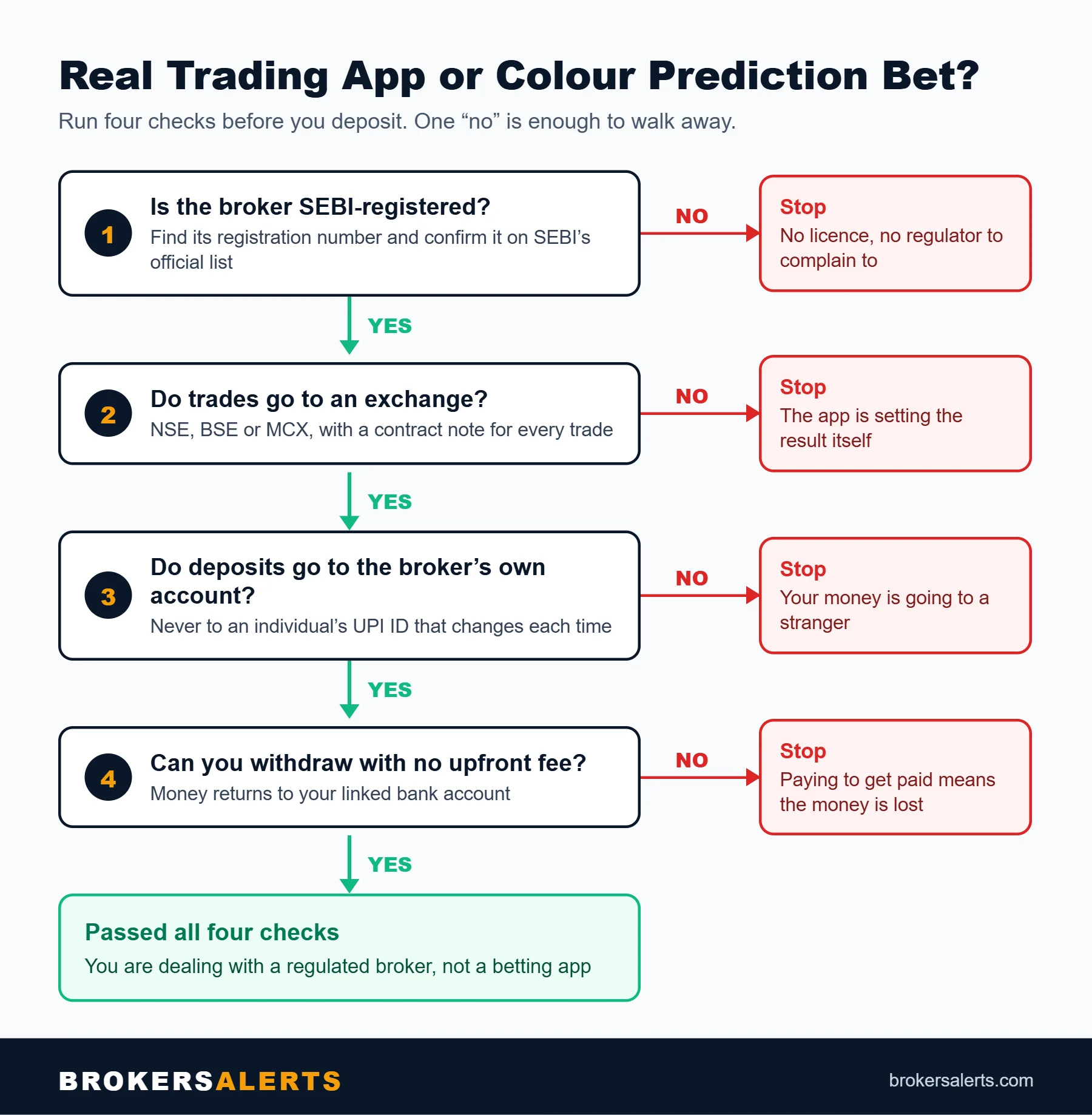
A legitimate trading app is run by a SEBI-registered broker, routes your orders to a recognised exchange, and moves money only between your own bank account and the broker. Run these four checks before you deposit anything:
- Registration. Find the broker’s SEBI registration number and confirm it on SEBI’s official list of intermediaries.
- Exchange. Every trade should go to an exchange such as NSE, BSE or MCX and come with a contract note.
- Payments. Deposits should go to the broker’s own account, never to an individual’s UPI ID that changes each time.
- Withdrawals. Money should come back to your linked bank account with no upfront fee.
One failed check is enough to walk away.
The same logic applies to forex and CFD platforms. Our Scam Warning list shows brokers that failed our checks, and you can browse every platform we’ve assessed in our broker reviews.
What Should You Do If You’ve Already Lost Money?
Act quickly, because the first few hours give the best chance of money being held before it moves on. Work through these steps in order:
- Stop paying. Don’t send any fee, tax or deposit to unlock a withdrawal.
- Save the evidence. Keep screenshots of your wallet balance, UPI IDs and transaction IDs, the app name and website, and every chat with support or an agent.
- Report it. Call the national cybercrime helpline on 1930 or file a complaint on the National Cyber Crime Reporting Portal.
- Tell your bank. Share the transaction IDs and ask whether any payments can be disputed or flagged.
- Secure your phone. Uninstall the app and any hack tools, then change your UPI PIN and banking passwords.
- Ignore recovery offers. People who promise to get your money back for an upfront fee are usually running a second scam on the same victims.
Did an app sell itself to you as a trading platform? Tell us what happened. Every report is reviewed within 48 hours, and verified cases feed our reviews and warnings so the next person can spot it sooner.
Frequently Asked Questions
Can I Make Money From Colour Trading?
You might win in the short term, but you can’t make money from colour trading over time. The payout table gives the operator an edge on every round, and nothing stops the app from refusing larger withdrawals.
Is Colour Trading Legal or Illegal in India?
Colour trading is illegal to offer, advertise or process payments for in India. The Promotion and Regulation of Online Gaming Act, 2025 bans online money games, and colour prediction apps fall within that ban.
Is Colour Trading Real or Fake?
The bets are real, and so is the money you lose. The “trading” part is fake. You aren’t buying any asset, and the app controls both the result and your balance.
Which Trading Is Legal in India?
Trading shares, mutual funds, and equity, commodity and currency derivatives through a SEBI-registered broker on a recognised exchange is legal. Forex trading is allowed only in permitted INR currency pairs on Indian exchanges, through registered brokers.
Which Trading Is Not Allowed in India?
Colour trading and other online money games are banned. Retail forex trading through overseas online platforms is also not permitted, and RBI keeps an alert list of unauthorised forex platforms. Dabba trading, where trades never reach an exchange, is illegal too.
Can I Make 1,000 Rupees per Day From Trading?
Not reliably, and anyone who promises a fixed daily income is selling something. Real trading returns go up and down, and most retail traders in derivatives lose money. Colour prediction apps have a built-in loss on every round.
Is a Colour Prediction Game Legal If It Is a Game of Skill?
No. The 2025 Act bans online money games whether they rely on skill, chance or both. Colour prediction is a game of chance anyway, since no skill can influence a result the app generates.
Risk warning: This guide is for general information and isn’t legal or financial advice. Trading and investing carry a risk of loss, and you may lose more than you put in with leveraged products. Online money games, including colour prediction apps, are prohibited in India. Read our full risk disclaimer before acting on anything you read here.