
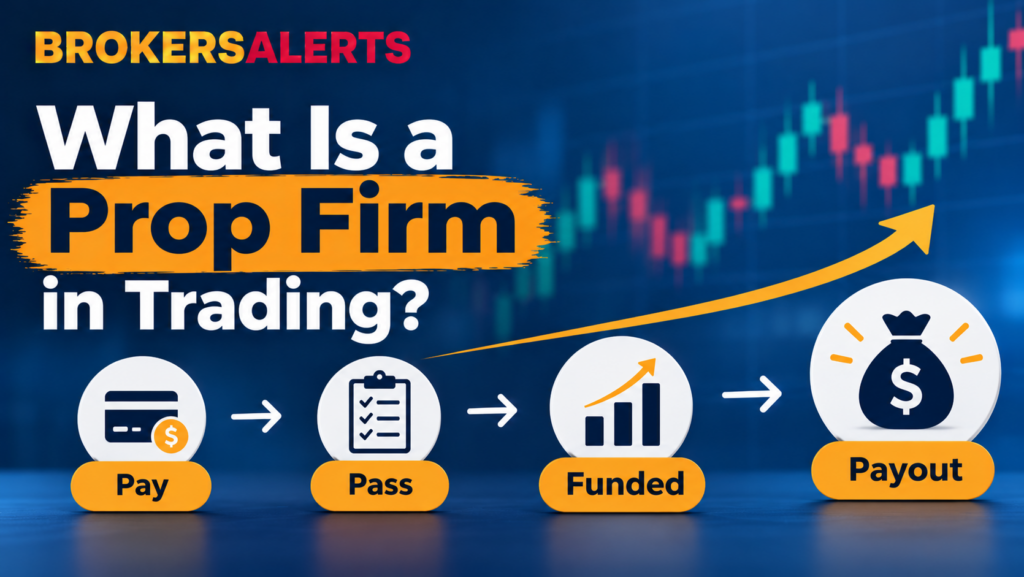
What is a prop firm? In trading today, it’s a company that lets you trade its capital after you pass a paid test. Pass, and you keep most of the profits you make. Fail, and you lose the fee.
That’s the pitch, anyway. In practice, the model works quite differently from what the ads suggest. Most funded accounts are simulated, most traders never reach a payout, and most of these firms aren’t regulated like brokers.
None of that makes every prop firm a scam. It does mean you should understand the business before you buy a challenge. This guide explains how prop firms work, where their money comes from, and how to check one before you pay.
Quick answer: A prop firm (proprietary trading firm) gives traders access to a funded account after they pass an evaluation, usually called a challenge. You pay an upfront fee, trade under strict risk rules, and if you pass, you earn a share of profits, often 80% to 90%. Most retail prop firms use simulated accounts and earn much of their revenue from challenge fees.
Prop Firm vs. Broker vs. Traditional Prop Desk
The term “prop trading” covers two very different businesses. Mixing them up is where most confusion starts.
| Information | Retail prop firm | Forex or CFD broker | Traditional prop trading desk |
|---|---|---|---|
| What you pay | Challenge fee, often refundable on first payout | Your own deposit | Nothing, you’re hired |
| Whose money is at risk | Firm’s (usually simulated) | Yours | The firm’s real capital |
| How you earn | Profit split, often 80% to 90% | All profits, minus costs | Salary plus bonus |
| Main revenue for the firm | Challenge fees, plus some trading profits | Spreads, commissions, swaps | Trading profits |
| Usually regulated? | Often not | Should be | Yes, as part of a bank or licensed firm |
| Who it’s for | Retail traders with a strategy, little capital | Anyone trading their own money | Professional hires |
In short, a retail prop firm sells access to capital. A broker executes trades with your money. A traditional prop desk employs traders to grow its own balance sheet.
Where the Term “Prop Trading” Comes From
Proprietary trading originally meant banks and investment firms trading their own money for their own profit, rather than for clients. That model still exists, inside large institutions and specialist trading firms.
The retail prop firm is a newer, online version. Instead of hiring traders, these firms let anyone apply by paying for an evaluation. The name stuck, even though the business model changed almost completely.
How Do Prop Firms Work? The Process Step by Step
Almost every retail prop firm follows the same basic path. Names and numbers differ, but the structure rarely does.
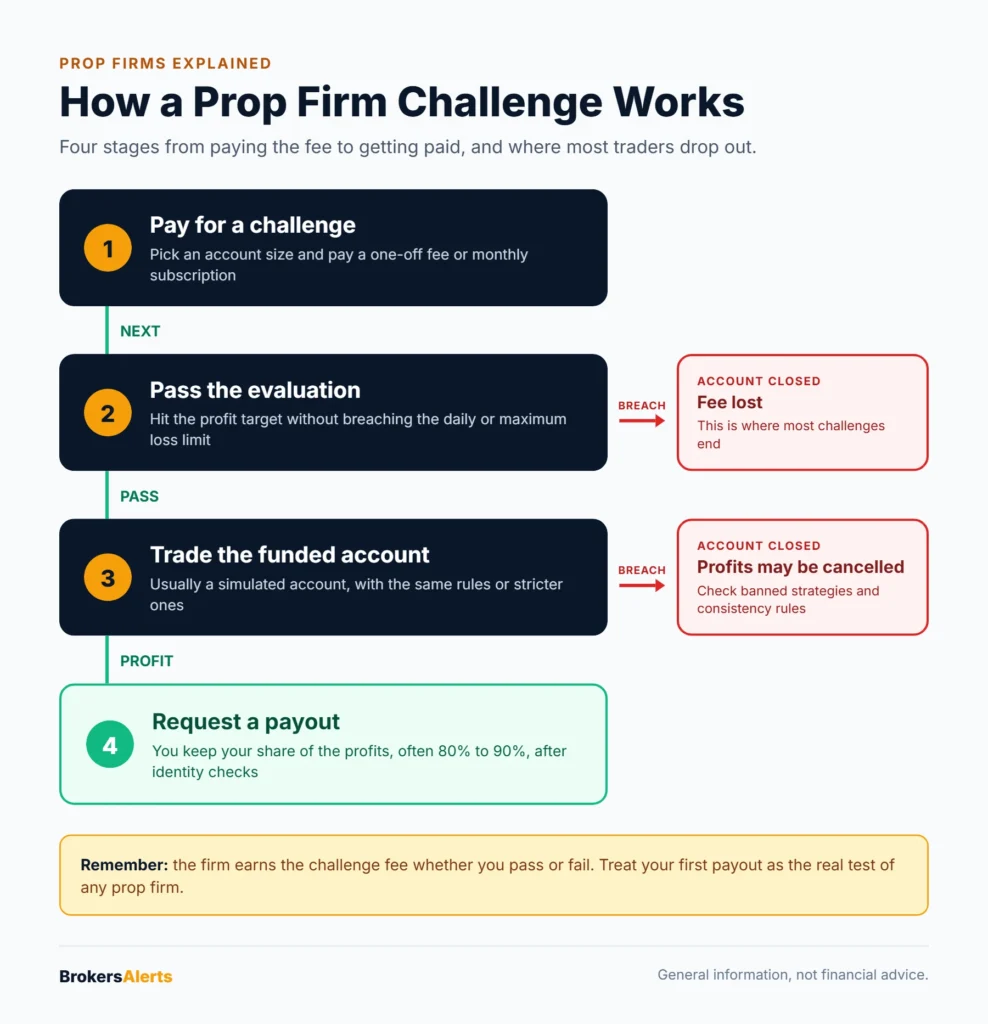
- You choose an account size. Typical options run from $5,000 to $200,000 in virtual capital. Bigger accounts cost more.
- You pay for the challenge. The fee is a one-off payment or, at many futures firms, a monthly subscription.
- You trade under risk rules. You need to hit a profit target without breaching loss limits, often within set conditions.
- You pass and sign a trader agreement. At this stage, the firm usually runs identity checks.
- You trade the funded account. The same rules continue to apply, sometimes stricter ones.
- You request a payout. If everything checks out, the firm pays your share of the profits, typically every two to four weeks.
Break one rule at any stage, and the account usually closes immediately. There’s no margin call or second chance. That’s the part beginners underestimate most.
What Is a Prop Firm Challenge?
A prop firm challenge, also called an evaluation, is a paid trading test. It proves you can make money while controlling risk. Here are the most common formats:
| Format | How it works | Typical targets |
|---|---|---|
| Two-step challenge | Pass two phases in a row | 8% to 10% in phase 1, around 5% in phase 2 |
| One-step challenge | One phase, usually tighter loss limits | Around 10% |
| Three-step challenge | Lower targets spread across three phases | 5% to 6% per phase |
| Futures evaluation | Monthly fee, profit target in dollars, trailing drawdown | Varies by account size |
| Instant funding | No test, higher fee, stricter rules from day one | No target to qualify |
Most challenges no longer have a time limit. A few still do, so check before you buy.
What Is a Funded Account?
A funded account is the account you trade after passing the challenge. In most retail prop firms, it is still a simulated account. Your trades are tracked on demo servers, and the firm pays you out of its own revenue when you make a profit.
Some firms copy the trades of consistently profitable traders onto real market accounts. Others never place real trades at all. Either way, you’re not handed a pot of live capital to manage, despite the marketing.
Profit Splits, Payouts and Scaling Plans
The profit split decides how much you keep. Most firms offer 80% to 90%, and a few advertise up to 100% on the first payout. The challenge fee is often refunded with your first payout too.
Payout schedules vary. Many firms pay every 14 days, some weekly, and some on demand after a minimum number of trading days. Meanwhile, scaling plans raise your account size, often by 25% or more, after a run of profitable months.
Before you rely on any of this, though, read the payout terms. Minimum withdrawal amounts, waiting periods and extra identity checks all affect when the money actually reaches you.
Prop Firm Rules Explained in Plain English
Prop firm rules decide whether you get paid. Every firm words them differently, so learn the concepts first.
- Profit target: The gain you need to pass a phase, usually a percentage of the starting balance.
- Daily loss limit (daily drawdown): The most you can lose in one day, often 4% to 5%. Some firms count open trades in it, not just closed ones.
- Maximum loss (max drawdown): The total loss allowed before the account closes, often 8% to 10%.
- Static drawdown: The loss limit stays fixed at your starting balance.
- Trailing drawdown: The loss limit moves up as your balance rises. Profits can therefore shrink your room for error, a common trap in futures evaluations.
- Minimum trading days: The fewest days you must trade before passing or withdrawing.
- Consistency rule: No single day can make up more than a set share of your total profit, often 30% to 50%. One big winning day can delay a payout.
- News and weekend rules: Some firms ban trading around major news releases or holding positions over the weekend.
- Prohibited strategies: Copy trading, hedging between accounts, high-frequency bots and “gambling” behaviour are frequently banned. Breaking these rules can cancel your profits even after you’ve been paid.
The last point matters most. Vague wording around “prohibited strategies” gives a firm room to refuse payouts. Read it before you trade, not after.
How Do Prop Firms Make Money?
Retail prop firms make most of their money from challenge fees, not from trading. That single fact explains almost everything else about the industry.
Think about the numbers. Thousands of traders buy evaluations every month. Only a small share pass, and fewer still reach a payout. The fees from everyone who fails fund the payouts to the few who succeed, with a margin left for the firm.
Other revenue streams exist too:
- Resets and retries. Many firms sell a discounted retry after a failed challenge, or a reset of the same account.
- Add-ons. Higher profit splits, faster payouts or removed time limits often cost extra.
- Broker partnerships. Some firms receive a share of spreads or commissions from the broker or platform they route to.
- Real trading profits. A minority copy their best traders into live accounts and keep part of the gains.
This doesn’t make the model fraudulent on its own. It’s closer to a skills competition with an entry fee. However, it does mean the firm profits whether or not you do. Keep that in mind when you read the marketing.
How Many Traders Actually Pass?
Firms rarely publish full statistics, and the figures that do surface vary. Data that some firms have shared suggests that only around 5% to 15% of challenges are passed. The share of traders who go on to receive at least one payout is lower again.
Strict rules drive those numbers. Daily loss limits punish a single bad session, and trailing drawdowns punish volatility. Meanwhile, profit targets push traders to take more risk than they normally would. The result is a structure where most participants fail by design, not because they’re bad traders.
How Much Does a Prop Firm Challenge Cost?
Prices depend on the account size, the format and the market. As a rough guide:
| Account size | Typical two-step forex challenge fee |
|---|---|
| $10,000 | $80 to $120 |
| $25,000 | $180 to $250 |
| $50,000 | $250 to $350 |
| $100,000 | $450 to $600 |
| $200,000 | $900 to $1,100 |
Futures firms work differently. They usually charge a monthly evaluation fee and then a one-off activation fee once you pass.
The Real Cost of Getting Funded
The price on the checkout page isn’t the true cost. Instead, look at what it takes to pass.
Here’s a simple illustration. Say a $100,000 challenge costs $500 and roughly one attempt in ten passes. On average, a trader would spend around $5,000 in fees before getting funded. Many will spend far less, and some far more, but the maths rarely appears in the ads.
Compare that with the upside. A funded trader who makes 5% in a month on a $100,000 account, with an 80% split, earns $4,000. That’s a real opportunity for a skilled trader. It’s also why so many people keep paying for one more attempt.
Are Prop Firms Worth It?
Prop firms can be worth it for a narrow group: traders with a tested strategy, strict risk control and little capital of their own. For them, a few hundred dollars buys exposure to a large account without risking life savings.
For beginners, the picture changes. You’ll pay to learn under rules built to catch mistakes. A demo account teaches the same lessons for free.
Ask yourself three questions before you buy:
- Have you been consistently profitable on your own account for at least several months?
- Does your strategy fit the firm’s daily loss limit and drawdown type?
- Can you afford to lose the fee, and the next one, without chasing it?
If any answer is no, wait. The challenge will still be there next quarter.
Are Prop Firms Legit or a Scam?
Many prop firms are legitimate businesses that pay their traders. Others have closed overnight, changed rules mid-month or refused payouts on technicalities. The industry is too young and too lightly supervised to treat as one category.
Are Prop Firms Regulated?
Most retail prop firms are not regulated as financial firms. Because they don’t hold client deposits or execute trades for you, many argue they sell a service, much like a trading course. As a result, they often operate without a financial licence.
That has real consequences. There’s no regulator to complain to, no compensation scheme if the firm collapses, and no rule forcing it to keep your fee separate from its own money. Your protection is the contract you signed and the firm’s reputation, nothing more.
The broker behind the firm matters too. Many prop firms route trades through an offshore broker, so check that licence as well. Our guides on what an FSA license actually covers and what a CySEC license protects explain how much weight each one carries.
What Recent Shake-Ups Taught Traders
The last few years delivered a hard lesson. In 2023, a US regulator took action against one of the largest forex prop firms, and its operations froze. Traders waited months without access to their accounts, whatever the final legal outcome.
Then, in early 2024, a major trading platform provider stopped serving many prop firms. Several firms paused new challenges, moved platforms in a hurry or shut down completely. Some traders lost funded accounts they had paid and worked for.
In both cases, traders who followed every rule still lost access. The risk sat with the firm, not with their trading.
Red Flags Before You Pay for a Challenge
Watch for these warning signs. One alone isn’t proof of a scam, but several together should stop you.
- No company details. No registered legal name, company number or physical address in the terms.
- Vague payout rules. Phrases like “at the firm’s discretion” or undefined “prohibited strategies”.
- Rules that change mid-cycle. Terms updated after you’ve already paid, with no grandfathering.
- Constant flash sales. Discounts of 50% to 90% every week point to a firm that lives on fee volume.
- No verifiable payouts. Only screenshots on social media, never independent proof.
- Pressure tactics. Countdown timers, “last chance” offers and influencer codes pushing you to buy today.
- A broker you can’t check. Trades routed through an unlicensed or unnamed broker.
- Hidden fees at payout. Surprise “processing”, “verification” or “activation” charges before you can withdraw.
How to Vet a Prop Firm in 15 Minutes
Run through this checklist before you spend anything. It takes less time than the challenge’s first trade.
- Find the legal entity. Look for the company name and country of registration in the terms. Then confirm the company exists in that country’s business register, such as the UK’s Companies House register.
- Read the full rulebook. Pay special attention to drawdown type, the consistency rule and the list of banned strategies.
- Check the payout terms. Note the minimum withdrawal, the payout frequency and any conditions on your first withdrawal.
- Identify the broker and platform. Then verify the broker’s licence using our guide on how to check if a broker is regulated.
- Search for complaints. Look for patterns, especially denied payouts and closed accounts, rather than single angry reviews.
- Check our watchlists. See whether the firm or its broker appears on our Scam Warning list.
- Start small. Buy the smallest challenge first, and request a payout as early as the rules allow. That’s the only test that really counts.
If you trade from India, there’s one more step. Rules on paying foreign trading platforms are strict, so read whether forex trading is legal in India before you buy a challenge.
Paid but Never Got Paid?
If a prop firm refused a legitimate payout, closed your account without explanation or vanished with your fee, tell us. We log every report, check it against others, and use the evidence in our reviews and warnings. You can also read How We Review to see how reports feed into our ratings.
Frequently Asked Questions
Do Prop Firms Use Real Money?
Mostly, no. The majority of retail prop firms run funded accounts on simulated servers. They pay profits from their own revenue, which comes largely from challenge fees. A few mirror top traders’ positions in live markets, but you rarely control real capital directly.
How Much Is a 100K Prop Firm Account?
A $100,000 two-step forex challenge typically costs between $450 and $600. Futures firms usually charge a monthly fee for a similar evaluation, plus an activation fee once you pass. Discounts are common, so the listed price is rarely what people pay.
What Happens If You Lose Money in a Prop Firm?
You don’t owe the firm anything beyond the fee. If you break a loss limit, the firm closes the account and you lose what you paid for it. Unlike a leveraged broker account, you can’t go into debt.
How Much Do Prop Firms Pay You?
You earn a share of the profits on your funded account, usually 80% to 90%. There’s no salary. If a $50,000 account makes $2,000 in a month and your split is 80%, you receive $1,600.
Is Prop Firm Trading Illegal?
No, it’s legal in most countries. However, many prop firms operate without a financial licence, so you have limited protection if something goes wrong. Some countries also restrict sending money abroad for trading, so check your local rules first.
Do Prop Firms Actually Pay Out?
Established firms do pay out, and many traders receive regular payouts. Still, payout denials over rule breaches are among the most common complaints in this industry. The safest proof is your own: request a small payout early.
What Is the Consistency Rule in a Prop Firm?
The consistency rule caps how much of your total profit can come from a single trading day. If the cap is 40% and one day delivers half your gains, you’ll need to keep trading before you can withdraw. It’s meant to stop one lucky trade from passing an evaluation.
Can Beginners Use a Prop Firm?
They can, but it’s rarely a smart starting point. Challenge rules punish the mistakes beginners make most, like oversized positions and revenge trading. Build a track record on a demo or small live account first.
The Verdict: A Useful Tool, Not a Shortcut
A prop firm sells access to a funded account in exchange for passing a paid test. For disciplined traders, that can be a cheap way to trade at scale. For everyone else, it’s often a series of fees with a payout that never comes.
The firms aren’t charities, and most aren’t regulated. They earn money whether you win or lose, which is fine as long as you understand that before you start. Read the rules, check the company, and treat your first payout as the real test of any firm.
Wondering whether trading itself is the problem? Our evidence-based look at Is Forex Trading a Scam? covers what we found when we tested brokers with our own money.
Risk warning: Trading forex, futures and CFDs carries a high risk of loss, and most traders who buy prop firm challenges do not pass them. This guide is general information, not financial advice. Only spend money on evaluations that you can afford to lose. Read our full risk disclaimer.